
cybersecurity-certification

Search "cybersecurity certifications" and you'll get a wall of acronyms within seconds. Security+, CISSP, CEH, CISM, GIAC, CySA+. No clear hierarchy. No signal about which ones actually matter for landing a job in 2026. At ThinkCyber International, we work with beginners and career changers every day, and the question we hear most often isn't "how do I learn cybersecurity?", it's "which cert should I get first?"
That's the right question, and it deserves a straight answer. The wrong certification won't just waste your time and money, it can position you poorly for the exact roles you're targeting. The right certification, sequenced correctly, signals to employers exactly what they need to see at each hiring stage.
This guide cuts through the noise. By the end, you'll understand the difference between cert types, know which credentials employers list most in job postings, see how they map to specific roles, understand what they actually cost, and have a concrete starting point based on where you are right now.
Before naming any specific credential, you need to understand the foundational split that shapes every certification decision. Vendor-neutral certifications, such as CompTIA Security+, ISC2 CISSP, and CISM, test concepts that apply across any environment, any tool stack, and any industry. They don't care whether your company runs Splunk or Microsoft Sentinel, AWS or Azure. They test whether you understand the underlying security principles that transfer everywhere.
This matters enormously for beginners. Most employers hiring junior analysts want cross-platform knowledge, not someone fluent in one vendor's ecosystem. Vendor-neutral certifications show up in the widest range of job postings, especially at entry and mid-level, precisely because the hiring manager doesn't yet know which tools their new hire will need to learn on the job.
Vendor-specific certifications, such as AWS Security Specialty, Microsoft SC-200, or Splunk Core, become powerful in a different context. They work best when a job description explicitly names a platform. If the posting says "must have experience with Splunk" or "Azure security required," a vendor certification for that platform becomes a strong differentiator. Think of vendor-specific credentials as a second layer you add once you know which stack you're targeting, not the foundation you build first. For a deeper comparison of the trade-offs between vendor-specific and vendor-neutral options, see this guide on vendor-specific vs vendor-neutral certifications.
Job posting analyses tell a consistent story for entry-level roles: CompTIA Security+ is the most commonly requested baseline credential in U.S. cybersecurity postings. A 400-job analysis confirmed Security+ as the top certification in entry-level listings, while CyberSeek data shows it appearing in a very large share of cybersecurity job ads. ISC2 Certified in Cybersecurity (CC) and the Google Cybersecurity Certificate also appear as alternative starting points, particularly for candidates building toward Security+, but neither carries the same hiring signal. For a current roundup of which credentials are trending, see this list of the top cybersecurity certifications for 2026.
Security+'s dominance at entry level comes down to three factors: it is widely recognized for government-adjacent roles under DoD 8140 workforce policy, it carries broad employer recognition across industries, and it has no formal prerequisites. First-attempt pass rates are estimated at roughly 60, 75% based on training provider surveys and community data, no vendor publishes official figures, making it the most accessible of the major credentials.
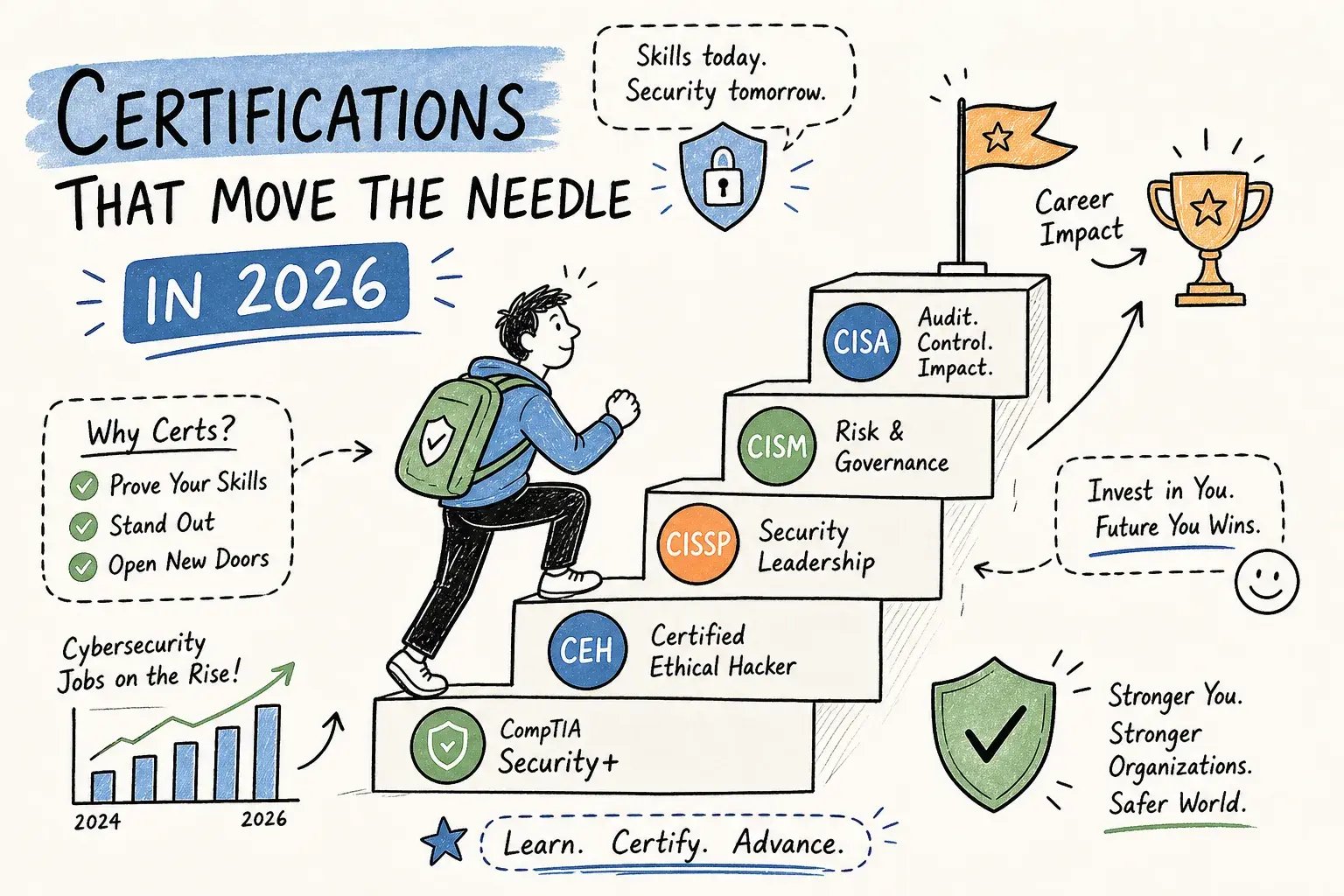
For mid-level and advanced roles, the landscape shifts significantly. CISSP is the single most-requested security certification overall in job posting analyses, and the salary data backs up why candidates pursue it: CISSP holders in the U.S. report median total compensation in the range of $150,000, $164,000, according to ISC2 and industry salary surveys. CISM and CISA are strongest for governance, risk, and compliance tracks. CEH is the go-to for offensive security paths. GIAC certifications carry serious weight in technical roles, often tied to SANS training, and are considered among the most rigorous credentials available. Advanced certifications like CISSP and CISM correlate with roughly 20, 30% salary uplift over uncertified peers in North America, based on compensation studies from ISC2 and ISACA.
Each career path has a different optimal credential sequence, and picking the wrong cybersecurity certification for your target role costs you both time and interview opportunities.
Vendor-neutral certifications dominate these postings. Security+, CySA+, and SSCP show up repeatedly because SOC environments span multiple tools and require conceptual breadth. CySA+ is a frequently overlooked option for beginners, despite being the most directly relevant post-Security+ credential for detection and analysis work, it maps specifically to blue-team tasks like log analysis, behavioral analytics, and incident response. When a posting explicitly names a SIEM platform like Splunk or Microsoft Sentinel, adding the relevant vendor certification strengthens your application on top of that neutral foundation.
Offensive security positions value hands-on skills that transfer across environments, so OSCP-style credentials carry the most weight. Vendor-specific credentials matter here only when the role targets a named environment. Cloud security engineer roles are unique in that both types matter equally: CCSP and CCSK cover vendor-neutral cloud security principles, while AWS Security Specialty, Azure security certifications, and Google Cloud security credentials become essential once the cloud platform is named in the posting.
This is the clearest case for vendor-neutral credentials. CISSP and CISM are the strongest fits because these roles prioritize risk management frameworks and governance breadth over platform mastery. Treat them as three-to-five-year horizon goals, not starting points.
Most certification guides quote exam fees and stop there. The real investment includes study time, exam difficulty, and the ongoing renewal requirements that most candidates don't think about until two years in.
Security+ currently runs around $425 for the exam voucher from CompTIA, with no formal prerequisites beyond recommended networking knowledge. First-attempt pass rates are estimated in the 60, 75% range by training providers and community surveys, vendors do not publish official rates, making it genuinely challenging but the most accessible of the major credentials. Renewal runs through CompTIA's CE program: 50 continuing education units over a three-year cycle, plus an annual maintenance fee of $50. For an up-to-date breakdown of exam voucher pricing and related expenses, see this article on the Security+ certification cost.
CISSP is a different category entirely. The exam fee is $749 in the Americas, and the difficulty is substantial: estimated first-attempt pass rates cluster around 50, 60%, with many candidates failing because they approach it as a technical exam rather than a management-level credential. CISSP also requires five years of qualifying paid work experience in at least two of its eight domains before you can certify. Renewal requires 120 CPE credits over a three-year cycle plus a $135 annual maintenance fee. For a comprehensive breakdown of the exam fee, experience requirements, and maintenance costs, see this CISSP certification guide on CISSP certification cost and requirements. CISM runs $575 for ISACA members and $760 for non-members, with comparable difficulty to CISSP, but through a governance and management lens that particularly challenges candidates without managerial backgrounds.
The renewal requirements across all major cybersecurity certifications reinforce a simple truth: certifications are career-long investments, not one-time checkboxes. That ongoing commitment is actually a feature, not a drawback. It signals to employers that you stay current in a field where threats evolve constantly.
If you have no tech background and no prior security experience, start with Security+. It has no prerequisites, the broadest employer recognition at entry level, and the most accessible difficulty curve among the major credentials. If you want to build confidence before committing to the $425 exam fee, ISC2 CC is worth considering as a free or low-cost first credential that covers foundational principles. The sequence that works best for true beginners: ISC2 CC to build the mental model, Security+ to establish hiring-market credibility, and CySA+ as the logical next step toward detection and analysis roles. Add a vendor-specific cert once you've identified a target stack or employer.
Skip CISSP and CISM if you're starting from zero. The experience requirements exist for good reason, and attempting these credentials without the foundational background typically leads to exam failures, or, worse, earning a credential you can't leverage because you lack the domain knowledge to perform in interviews.
If you're already working in IT, helpdesk, sysadmin, or network support, you can often move directly to Security+ and plan for CySA+ or a relevant cloud certification within the next 12, 18 months. The key is assessing your target role first, then working backward. SOC analyst paths favor Security+ followed by CySA+. Offensive security leanings point toward CEH and eventually OSCP-style credentials. Security management should be a multi-year goal built on top of CISSP, not a starting point.
Certifications validate knowledge. They don't prove you can do the job under pressure, and increasingly, hiring managers know the difference. Portfolio evidence matters in technical interviews: lab walkthroughs, incident reports, actual tool experience. None of that comes from an exam. A CISSP can open a door; the interview closes it, and interviews test what you can actually do with the knowledge you've certified.
This is the gap that "cert-stacking" consistently fails to close. Candidates who collect credentials without applied practice often hit a wall in technical interviews, even when their resume looks strong on paper. The concepts are there; the execution under real conditions isn't.
ThinkCyber International's 12-month academy is built to address exactly this gap. This academy isn't designed to prepare students solely for certification exams but to ready them for real junior job positions. Through the Cyberium Arena lab platform, students work through real-world simulations covering SOC analysis, Linux forensics, Windows forensics, network packet analysis, and web application security, developing the hands-on capabilities that theoretical study alone can't deliver. Upon completing the academy, students undertake a live final project that showcases their knowledge and practical skills. After graduating, they receive an internationally recognized certificate, ready to apply practical knowledge, not just theoretical concepts. Learn more about our approach on about thinkcyber.
Choosing the right cybersecurity certifications isn't about collecting acronyms. It's about matching the right credential to the right career stage, the right target role, and the right level of hands-on preparation to back it up. For most beginners, that means Security+ as the first serious credential, CySA+ as the next step toward analyst roles, and vendor-specific certifications layered on top once a target stack or employer comes into focus.
The professionals who land junior roles fastest are the ones who combine verified knowledge through cybersecurity certification programs with demonstrated ability through hands-on labs and real project work. Vendor-neutral credentials build the cross-industry foundation that gets you hired; vendor-specific ones sharpen your edge for a particular role once you know where you're heading. Neither works in isolation from practical skills, and building both at the same time, with the right structure behind you, is what separates the candidates who pass interviews from the ones who only pass exams.